
The business context
Multi-location healthcare marketing is rarely a simple awareness problem. Each market has its own competitive pressures, referral patterns, commuter habits, household makeup, and patient expectations. What works for one urgent care or freestanding ER in one city can be inefficient, or even counterproductive, in another.
That was especially true in a network that stretched across very different geographies and demographics. The job was not merely to buy ads. It was to make every dollar work harder while supporting local growth and preserving brand consistency across the broader organization.
The real challenge: reach and frequency on a real-world budget
Many companies can afford reach or frequency, but not both if the strategy is sloppy. They can cast a wide net and fail to reinforce the message often enough, or they can repeat the message too often to too small an audience and stall growth. The work was about helping the organization stretch its marketing dollars to achieve both through a smarter use of data and creativity.
That idea influenced how campaigns were prioritized, how media channels worked together, and how market-level decisions were made.
Why a simple radius was not enough
Healthcare marketers often default to a fixed-radius mindset: draw a circle around a facility and assume everyone inside it is equally relevant. That can be an easy way to buy media, but it is often a poor reflection of how patients actually behave.
Some areas inside the radius may have low conversion potential, weak fit, or heavy competitive friction. At the same time, high-value opportunities may sit outside that simple circle because of travel patterns, work locations, population shifts, commuting corridors, or other local factors.
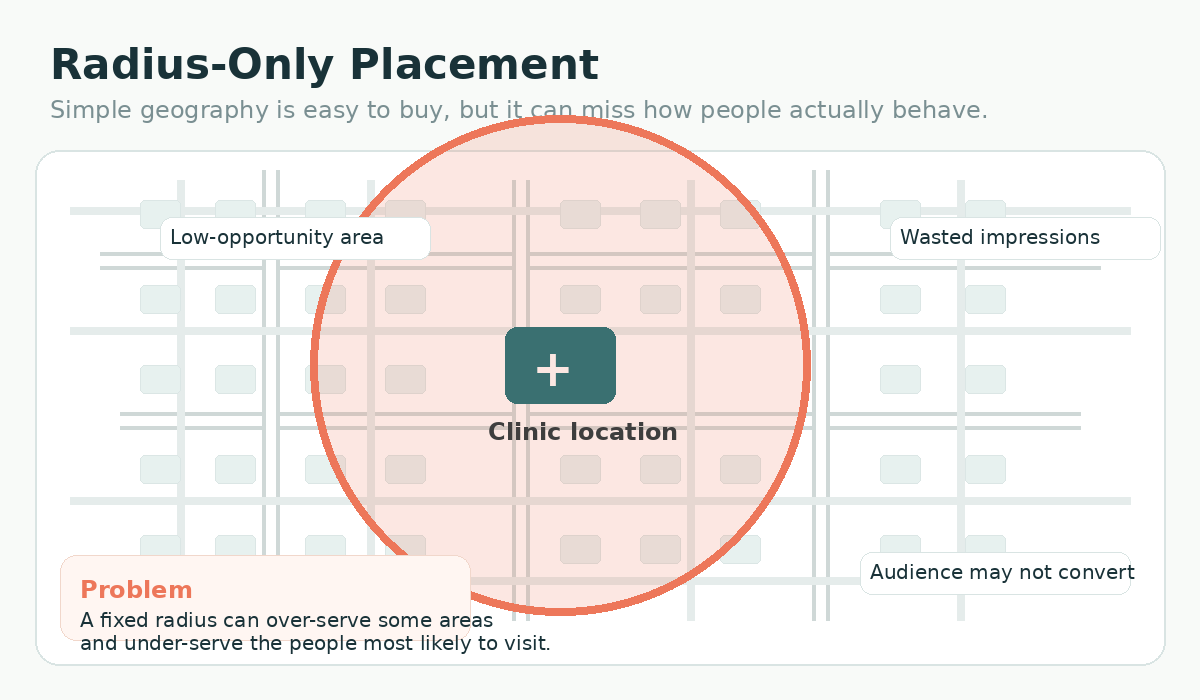
A broad circle may feel efficient, but it can waste impressions and over-serve low-opportunity areas.
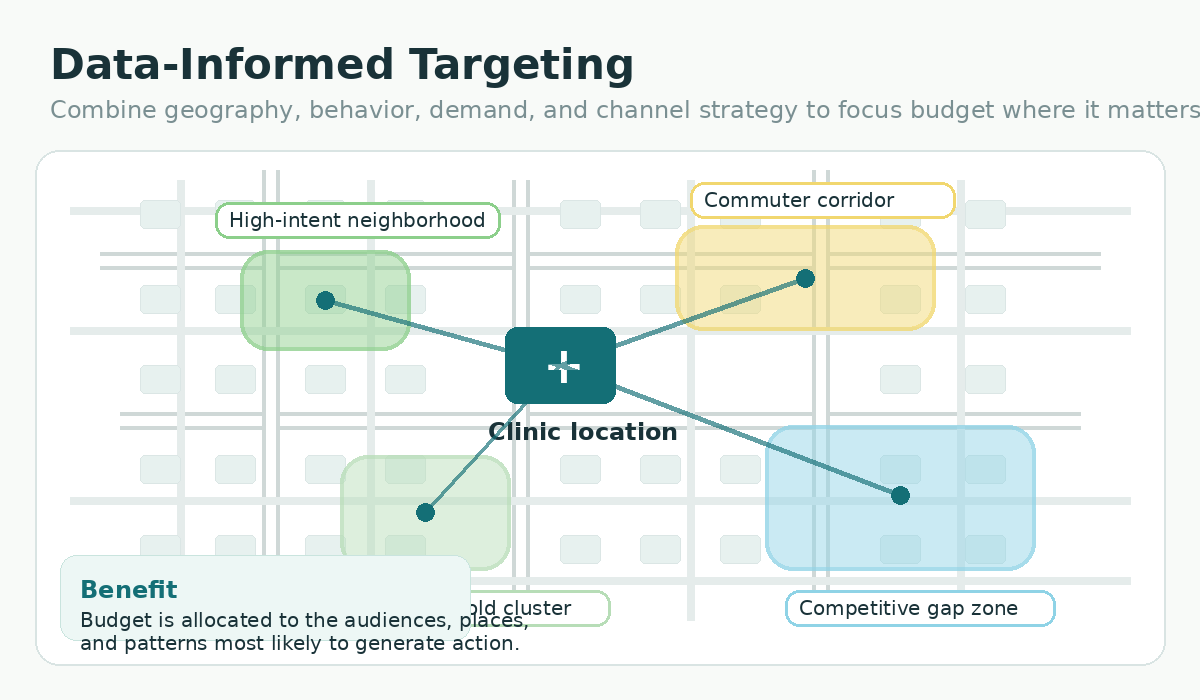
A better approach layers geography with behavior, demand, and channel strategy so the media budget follows the audience more intelligently.
The strategy stack
The work combined OTT, geofencing, Google Ads, and social media campaigns, but the real value came from how those channels were connected and informed. Rather than treating each platform as a silo, the strategy considered how they could support one another.
Channel mix
- OTT for broad awareness and message reinforcement
- Geofencing to focus on strategic real-world locations and behavioral patterns
- Google Ads to capture high-intent search behavior
- Social media to reinforce messaging, offers, and community visibility
Decision inputs
- Internal business knowledge and proprietary operating insights
- Market-level performance trends
- Local competition and access patterns
- Audience fit by location, not just by distance
- Creative relevance by market and service line
The point was not to use more tools. It was to use them with purpose so that placement, creative, and budget were working toward the same objective.
Using internal data without compromising HIPAA compliance
One of the most important parts of the work was staying compliant while still making informed decisions. We used internal proprietary information to guide strategy, but all sensitive healthcare data remained internal and was not shared with outside advertising platforms. That distinction mattered.
Campaign decisions were informed by internal knowledge, but outside platforms did not receive protected patient information. In other words, the intelligence was internal, the activation was external, and the boundary between the two was respected.
That allowed for stronger market intelligence while maintaining ever-important HIPAA compliance.
Creative and messaging discipline
Media efficiency alone is not enough. Good placement still needs creative that works. Messaging and visual identity had to remain recognizable across the network while still being flexible enough to reflect local needs, urgency, and service differences. The goal was not to make every market look different; it was to make every market feel locally relevant while remaining part of the same brand system.
This is where creative judgment mattered. Effective campaigns require more than a targeting setup. They require clear offers, recognizable branding, credible visuals, and repetition strong enough to create familiarity over time.
What this case study shows
Healthcare marketing is at its best when strategy is both analytical and practical. It requires budget discipline, respect for privacy, thoughtful creative, and a willingness to move beyond oversimplified assumptions like a one-size-fits-all radius. When done well, marketing dollars can be stretched further, messages can reach the right people more consistently, and the organization can achieve a healthier balance of reach and frequency.